
The science behind improving wellbeing
How research and partnerships inform Google Health recommendations
Built by Google,
backed by science
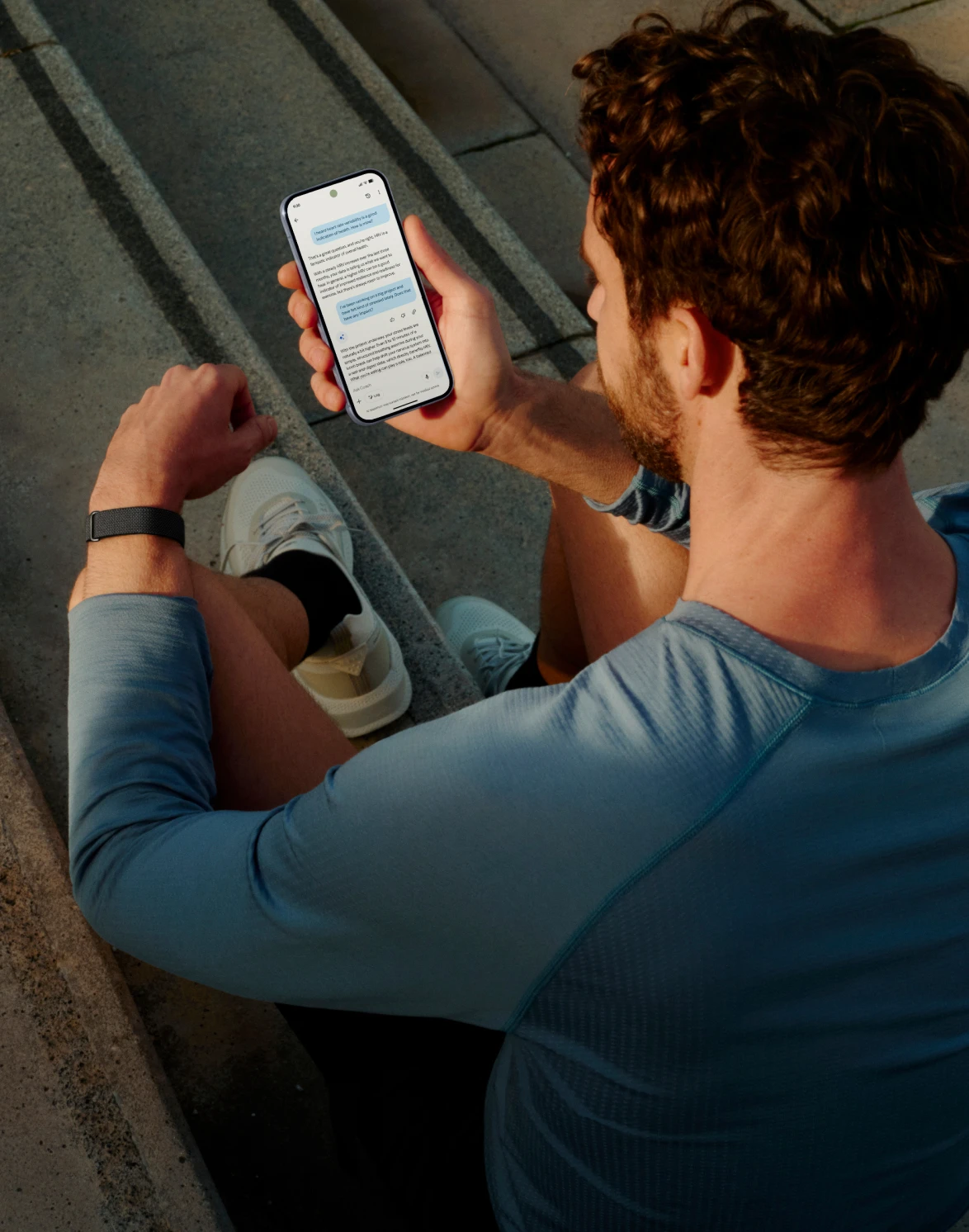
Cutting-edge AI research
Your coach is powered by Google's breakthroughs in generative AI. We're leading the research that makes adaptive and personalised health guidance possible.1

Deep clinical expertise
Our team combines clinicians, health researchers, behavioural change scientists and other experts to bridge rigorous medical science and real-world needs with technology solutions.

A history of health innovation
Our experience supporting wellbeing informs everything we build. We turn scientific advancements into practical tools that work in real life.
Rigorous research, real-world results
Measuring what matters
Measuring what matters
We track dozens of health signals like physical activity patterns, heart rate variability, sleep quality and stress markers for a holistic view of your wellbeing. These enable your coach to deliver personalised insights to help you improve. 1, 2, 3
1,800 more steps per day
Average increase for adults using wearable activity trackers4
24–52% lower risk
Of chronic disease for people with higher daily step counts5
Rigorous research, real-world results
Proven performance
Proven performance
Our devices and coaching technology are tested against clinical-grade measurement tools and expert review to ensure accuracy. We apply the same professional and clinical standards used to evaluate human experts, so you can trust how our AI coach performs.
88% vs 71%
AI coach score on professional fitness exams compared to human fitness experts6
79% vs 76%
AI coach score on professional sleep medicine exams compared to experienced sleep clinicians6
Rigorous research, real-world results
Real-world scale
Real-world scale
Our research spans thousands of participants and millions of hours of real-world data collected across diverse populations. Testing at this scale means that our research reflects how people actually live, not just in ideal lab conditions.
8 million users
Contributing heart rate variability data for global health research7
60 million hours
Of wearable sensor data used to train Google Health's AI models8



Validated by experts,
verified by you
- Nature
- Nature Medicine
- Nature Communications
- JMIR
- PNAS
- Circulation
- JAMA Psychiatry
- BMJ Mental Health
- NeurIPS
- ICLR
- ACL
Advancing knowledge, improving outcomes
Early detection of serious health issues
Wearable heart monitoring can identify irregular rhythms like atrial fibrillation or a sudden loss of pulse, helping ensure that you get care quickly when critical situations arise.7, 8, 9Increased physical activity
Personalised coaching can help turn small changes into lasting habits, building sustainable routines designed to improve overall health.1Better sleep habits
Tailored sleep insights are designed to improve both quality and duration, helping you rest deeper, recover faster and show up with more energy.1, 3Health Q&A
Immediate access to reliable answers helps you understand your wellbeing and make informed decisions whenever questions come up.Explore the full body of research behind Google Health
FAQ
-
Google devices are tested against clinical-grade measurement tools to ensure accuracy that you can trust. Our wearables track metrics like heart rate, sleep stages and activity using sensors validated through rigorous research. We hold ourselves to the same standards that research institutions use, because your decisions deserve reliable data. Accuracy varies by metric, but we publish detailed validation studies so that you can see exactly how our devices perform. The result is tracking that's precise enough to inform meaningful guidance.2, 3
-
Yes. Google Health is powered by published studies across physiology, behavioural science and health outcomes. Our health coach recommendations are grounded in peer-reviewed research about exercise, sleep, nutrition and behaviour change. We don't just reference existing science, we also conduct our own studies with leading universities and clinical experts to validate our approach. Everything from how we measure sleep quality to how we personalise fitness plans is informed by rigorous scientific evidence, ensuring that the guidance that you get is backed by real research.1, 3
-
Our research library includes validation studies from both Google researchers and independent third parties that have been published in peer-reviewed journals and are publicly accessible. You can find detailed accuracy studies covering how our devices measure heart rate, sleep stages, activity tracking and other health metrics. These studies show how our sensors perform against clinical-grade equipment and include methodology, sample sizes and results.2, 3
-
Our research library includes studies where Google Health devices and data have been used by researchers worldwide. You'll find peer-reviewed publications spanning cardiovascular health, sleep science, activity patterns, chronic disease management and more. We've supported research contributing to advances in health science at scale. The library is searchable by topic so that researchers, clinicians and anyone interested can explore how our technology advances health knowledge.
-
Google approaches AI safety for health with rigorous testing and transparency. Our AI health coach is built on peer-reviewed research and trained using established clinical guidelines for exercise, sleep and wellness. The guidance is developed with input from clinical researchers and behavioural scientists who help ensure that recommendations align with health best practices. We test the AI's recommendations against real-world health outcomes and continuously monitor its performance. Our research methodology is published openly so that the scientific community can review our approach and hold us accountable for building trustworthy health AI.1, 10
-
Our research library is a great starting point for researchers, where you can find published validation studies, observational studies and randomised controlled trials that have utilised our technology. You'll find details on our sensors, algorithms and metrics so that you can evaluate our technology for your studies.
-
Google Health can complement your clinical care by providing continuous health data between visits. Your patients can share their activity, sleep, heart rate and other metrics with you, giving you visibility into their daily health behaviours. This helps inform treatment decisions, track progress on health goals and identify potential issues early. The platform supports patient engagement by providing personalised guidance that reinforces your clinical recommendations. You can use the data to have more informed conversations about lifestyle changes, medication adherence and chronic condition management.1, 2, 3
-
Opportunities to participate in specific Google Health research studies are published directly in the Google Health app under the Health tab. You also have the option to share your data to be used in general ongoing research to improve product quality by selecting that option when you set up your device account.
-
Contributing your data to research is completely optional. If you choose to participate, your health and wellness data (like steps, heart rate and sleep) may be used to develop new health features and contribute to scientific research that advances our understanding of health and wellness. None of this data will include your name, email or other information that directly identifies you. You can review the full consent details and manage your preferences in the app at any time.
-
Requires Google Health Premium subscription (sold separately), Google Health app, Wi-Fi and Internet connection. Features subject to change; availability varies. Not intended for medical purposes. Gemini features work independently of Gemini apps. Check responses for accuracy; results may vary.
-
Not intended for medical purposes. Like all heart rate tracking technologies, accuracy is affected by physiology, location of device, and your movements and activity. Consult your healthcare professional before making changes regarding your health.
-
Not intended for medical purposes. Sleep tracking features are not intended to diagnose or treat any medical conditions and should not be relied on for medical purposes. They are intended to provide information that can help you manage your wellbeing. Consult your healthcare professional before making changes regarding your health.
-
https://www.thelancet.com/journals/landig/article/PIIS2589-75002200111-X/fulltext
-
https://www.thelancet.com/journals/landig/article/PIIS2589-7500%2820%2930246-6/fulltext
-
https://research.google/blog/sensorlm-learning-the-language-of-wearable-sensors/
-
Not intended for use by people under 22 years old with known atrial fibrillation or other known arrhythmias. Not available in all countries.
-
https://research.google/blog/the-anatomy-of-a-personal-health-agent/